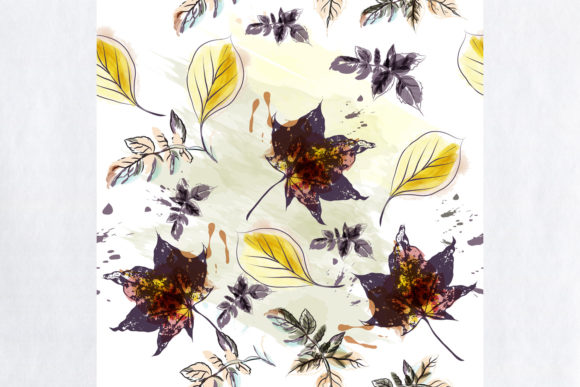
Designing with the Autumn Floral Pattern with Maple Leaves Vector Collection
The transition from summer to autumn brings a distinct shift in visual culture, moving from bright, saturated tones to a warmer, more textured aesthetic. For designers, educators, and business owners, capturing this seasonal essence requires assets that are both evocative and technically robust. The Autumn Floral Pattern with Maple Leaves serves as a prime example of how traditional hand-drawn characteristics can be preserved within a modern digital workflow. This specific collection, featuring 100 unique vector art elements, bridges the gap between organic illustration and scalable graphic design, offering a versatile toolkit for a wide array of creative projects.
Technical Specifications and File Compatibility
Understanding the technical foundation of a digital asset is crucial before integrating it into a professional workflow. This collection is structured to ensure maximum compatibility across different software environments and skill levels. The inclusion of multiple file formats addresses the diverse needs of modern creators.
- AiCS2 File: The Adobe Illustrator CS2 format ensures backward compatibility. While newer versions of Illustrator exist, CS2 remains a standard baseline that allows users with older software licenses or legacy systems to open and edit the source vectors without corruption. This is particularly valuable for educational institutions or small businesses that may not update their software annually.
- EPS10 File: Encapsulated PostScript version 10 is the industry standard for vector exchange. EPS10 supports transparency and complex gradients better than earlier versions while maintaining broad compatibility with non-Adobe vector editors like CorelDRAW, Affinity Designer, and Inkscape. This format guarantees that the 100 vector art pieces remain editable regardless of the primary design ecosystem.
- JPEG Preview (5000x5000 px): High-resolution raster previews serve a dual purpose. They allow for quick visual reference without launching heavy vector software, and they provide a print-ready fallback for users who do not require editing capabilities. At 5000 pixels square, this preview maintains sufficient DPI for large-format printing even if the vector files cannot be accessed.
It is important to note that mockups are excluded from the download. This distinction emphasizes that the product is a raw creative resource rather than a finished template, placing full artistic control in the hands of the user.
The Strategic Advantage of Vector Scalability
The defining characteristic of the Autumn floral pattern with maple leaves 100 vector art set is its infinite scalability. Unlike raster images, which degrade when enlarged due to pixel interpolation, vectors rely on mathematical paths. This technical difference has profound practical implications for cross-media campaigns.
Consider a scenario where a brand needs to apply an autumn theme across disparate touchpoints. A business card requires intricate detail at a small scale, while a storefront window decal demands the same artwork scaled up by 500%. With rasterized floral patterns, a designer would need to source or render multiple resolutions. With this vector collection, a single master file adapts perfectly to both contexts. The hand-drawn characteristics—the slight imperfections in line weight, the organic flow of the maple stems, and the delicate shading of the petals—are mathematically preserved. This ensures that the warmth and authenticity of the original illustration are not lost to pixelation or aliasing artifacts, regardless of the output size.
Applications Across Professional Sectors
The versatility of botanical vector art extends far beyond simple decoration. Different industries leverage these assets to solve specific communication challenges during the fall season.
Retail and Packaging Design
For consumer goods, autumn signals a shift in purchasing behavior associated with comfort, harvest, and preparation for winter. Product packaging utilizing the Autumn Floral Pattern with Maple Leaves can create immediate shelf recognition. Vectors allow packaging designers to wrap patterns seamlessly around boxes, bottles, and bags without visible seams or resolution loss. The ability to recolor vector elements means a single pattern set can support multiple product lines; warm oranges and reds might highlight spicy food products, while desaturated browns and golds could adorn premium tea or coffee packaging.
Educational and Academic Resources
Educators and researchers often require thematic visuals to engage students or present data in a contextually relevant manner. Fall-themed worksheets, lesson plans, and academic conference materials benefit from high-quality illustrations that avoid looking juvenile. The hand-drawn nature of this vector set provides a sophisticated yet approachable aesthetic suitable for adult learners and higher education. Because the files are editable, teachers can isolate specific maple leaves or floral clusters to create custom diagrams, biology charts, or literary analysis covers without needing advanced illustration skills.
Digital Marketing and Web Design
In the digital realm, performance is paramount. Vector graphics, when exported as SVGs for web use, offer significantly smaller file sizes compared to high-resolution PNGs or JPEGs. This contributes to faster page load times and improved SEO metrics. Furthermore, CSS can manipulate vector colors and opacity directly in the browser. A website featuring this autumn pattern can dynamically adjust the color palette to match dark mode preferences or accessibility requirements, ensuring the seasonal branding remains functional and inclusive.
Customization and Creative Workflow
Acquiring 100 individual vector elements provides a modular design system rather than a static background. Professional workflows typically involve deconstructing and reassembling these components to create bespoke compositions.
Color Grading and Palette Adaptation: One of the most significant advantages of vector art is non-destructive color editing. Designers can select all instances of a specific hue and globally shift them to match existing brand guidelines. If a company’s autumn campaign uses a specific Pantone shade of burnt sienna, the maple leaves in this pattern can be updated instantly to match, ensuring visual consistency across all collateral.
Composition and Density Control: Pre-made patterns often suffer from repetitive tiling that becomes obvious upon close inspection. By working with the individual 100 vector art pieces, designers can manually arrange elements to create organic, non-repeating layouts. This allows for directional flow, guiding the viewer’s eye toward key information such as headlines or call-to-action buttons. Elements can be scaled, rotated, and overlapped to create depth, transforming a flat pattern into a rich, layered illustration.
Integration with Typography: Hand-drawn florals pair exceptionally well with serif and script typefaces common in autumnal design. Because vectors share the same rendering engine as text in applications like Illustrator, designers can wrap text around floral elements or intertwine letterforms with maple stems. This tight integration creates a cohesive lockup where image and type feel like parts of a single unified composition rather than separate layers.
Evaluating Quality in Botanical Vector Art
Not all vector patterns are created equal. When selecting assets like the Autumn Floral Pattern with Maple Leaves, professionals should evaluate several quality indicators that distinguish premium resources from generic stock.
Path Complexity and Cleanliness: High-quality vectors feature optimized anchor points. Excessive nodes can result in jagged curves and bloated file sizes. This collection’s emphasis on hand-drawn characteristics suggests that the paths were likely created with careful attention to curve smoothness, balancing organic feel with technical efficiency. Clean paths are essential for die-cutting in print production and for smooth animation in motion graphics.
Artistic Cohesion: A set of 100 elements must share a consistent stylistic language. Line weights, stroke styles, and fill techniques should be uniform across all maple leaves and floral components. This consistency allows designers to mix and match any element from the set without creating visual discord. The description of the creation process as a "work of joy" often correlates with this level of artistic integrity, as passion projects tend to receive more meticulous attention to detail than mass-produced content.
Licensing and Usage Rights: While not explicitly detailed in the technical specs, understanding the licensing model is part of evaluating any digital asset. Users must verify whether the vectors are cleared for commercial use, editorial use, or extended licensing for merchandise. The flexibility of vector files makes them particularly valuable for merchandise, but this also necessitates clear rights management to avoid legal complications.
Support and Community Engagement
The value of a digital asset extends beyond the files themselves. The creator’s invitation to "drop a line" for assistance highlights an important aspect of the independent design marketplace: direct access to expertise. When working with complex vector sets, users may encounter questions about layer organization, color separation for screen printing, or optimal export settings for specific substrates. Direct communication with the artist can resolve these issues faster than generic documentation.
This human element reinforces the E-E-A-T (Experience, Expertise, Authoritativeness, and Trustworthiness) principles essential for evaluating creative resources. Knowing that the Autumn Floral Pattern with Maple Leaves was crafted with intention and supported by an engaged creator adds a layer of reliability that automated or anonymous stock libraries cannot provide. It transforms a simple file download into a collaborative creative relationship, fostering confidence in the asset’s quality and usability.
Ultimately, the decision to incorporate this vector collection should be driven by project requirements and technical alignment. Whether used for a local bakery’s seasonal menu, a university’s fall semester newsletter, or a multinational retail campaign, the combination of hand-drawn charm and vector precision offers a reliable foundation for autumnal visual storytelling. By leveraging the scalability, editability, and comprehensive scope of these 100 elements, creators can produce work that feels both timely and timeless, capturing the fleeting beauty of the season with enduring technical excellence.